
Table of Contents
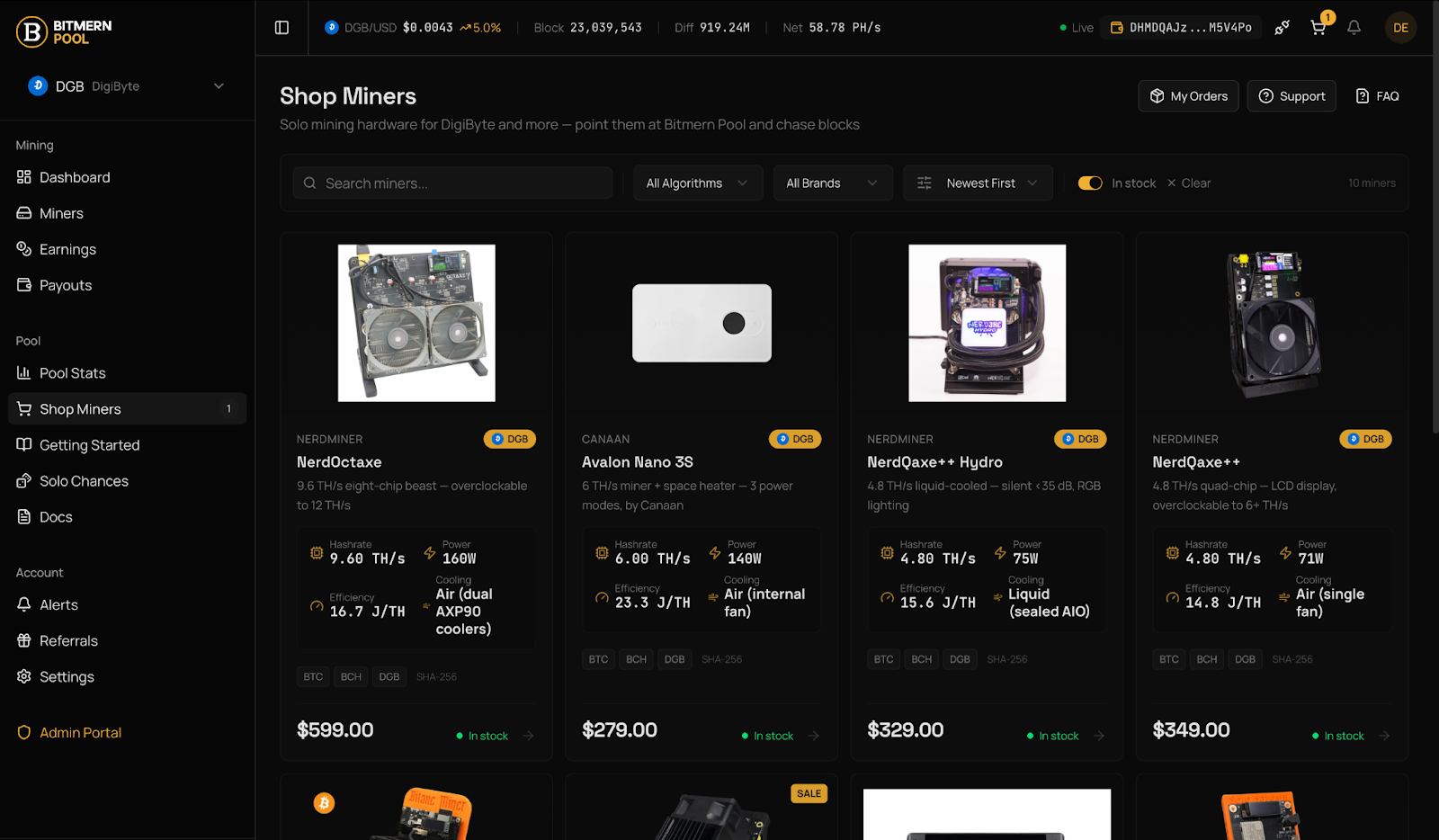
Bitmern Shop is now live inside bitmernsolo.com, and it addresses the single biggest failure point in solo mining: buying the wrong hardware for the wrong coin. Miners can now select a coin, review live pool statistics, calculate their solo probability, purchase matched hardware, and connect workers — all from one dashboard.
The shop sits inside Bitmern Solo Pool, a five-coin solo mining pool supporting Bitcoin, Litecoin, Dogecoin, Bitcoin Cash, and DigiByte with a flat 1% fee across all five.
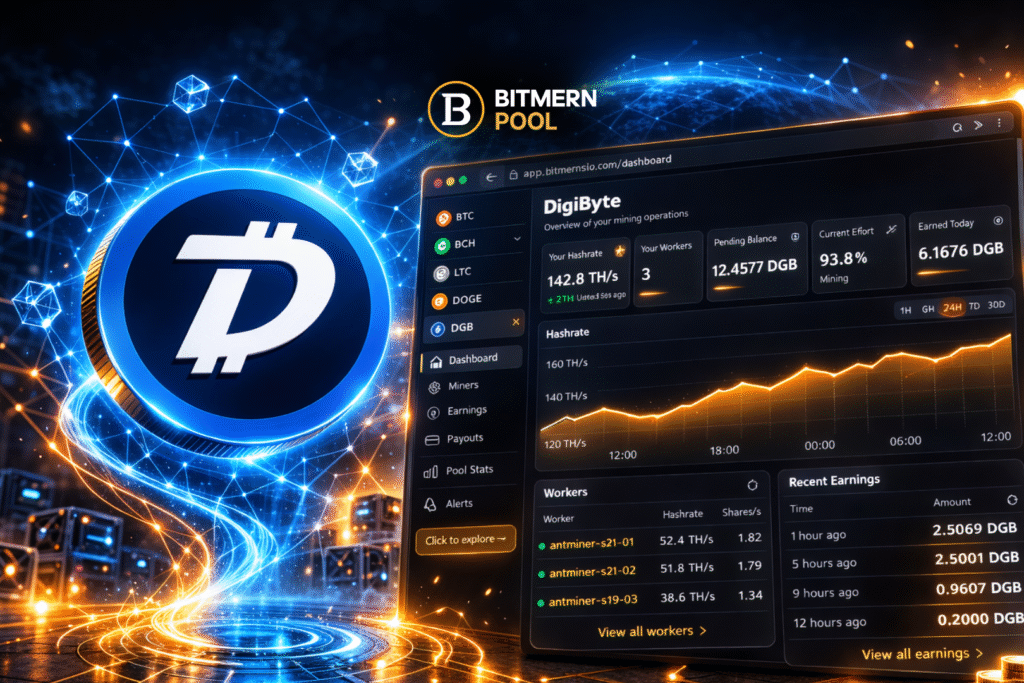
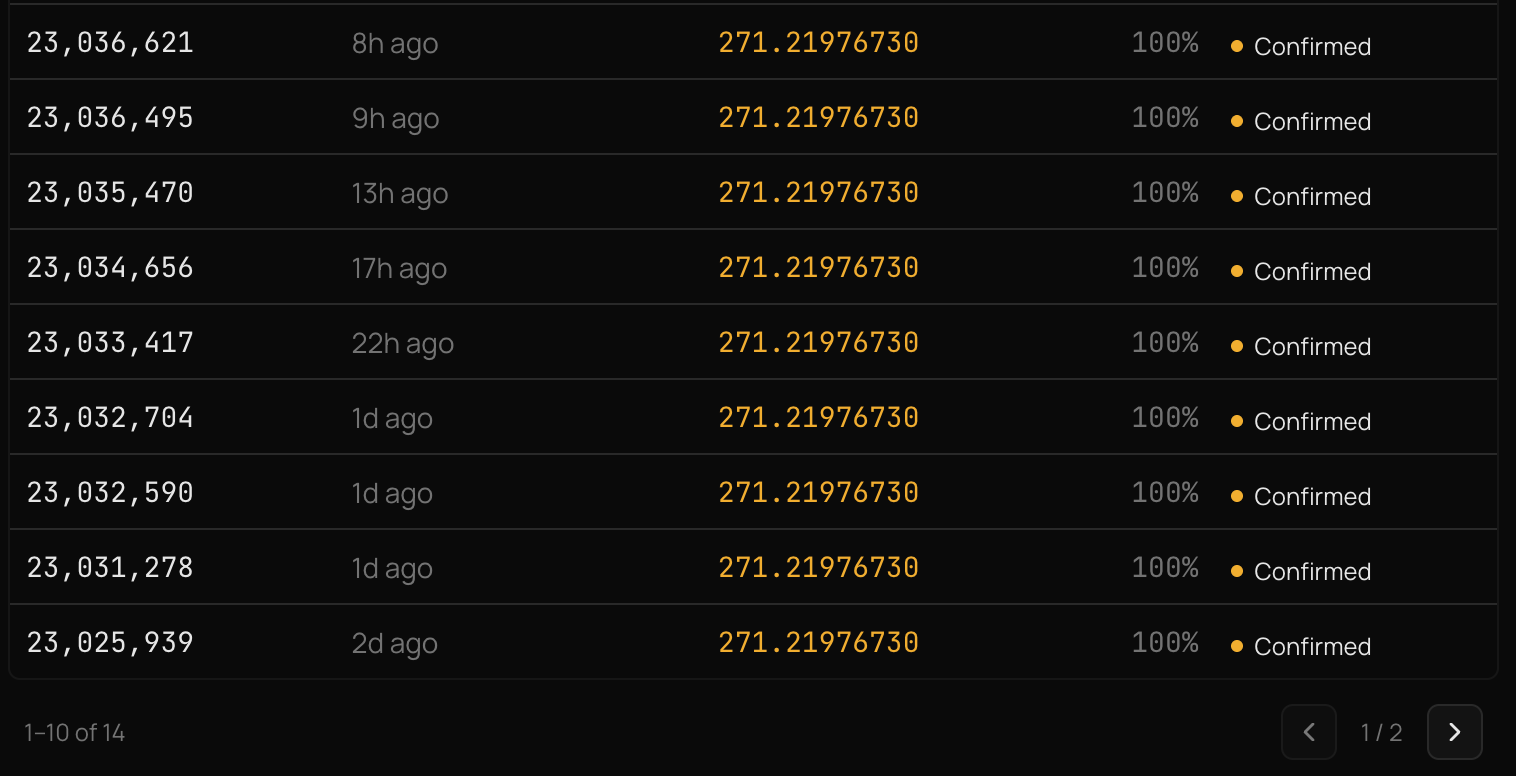
The pool launched in February 2026 and has already mined 30+ DigiByte blocks in its first six days — real blocks on a real network, not testnet output. That early production validates the infrastructure, but the shop is the bigger story. It turns what would otherwise be another solo pool endpoint into a vertically integrated mining system.
The timing matters. According to Solo Satoshi’s tracking data, over 22 solo miners found Bitcoin blocks in 2025, with the network hashrate crossing 1 Zettahash in late 2025. Rising participation and rising difficulty is exactly the environment where uninformed hardware purchases do the most damage.
Solo Mining’s Biggest Failure Happens Before Hashing Starts
The standard solo mining workflow in 2026 involves bouncing between four or five platforms. A miner researches hardware on a reseller site, checks network stats on a block explorer, estimates profitability on a third-party calculator, connects to a pool, and tracks performance on yet another dashboard. Each step introduces friction and information gaps.
The most common mistake is hardware mismatch. Someone buys a 1 MH/s miner expecting it to generate shares on a pool with 500,000-level difficulty, and the machine contributes nothing. CoinGecko’s solo mining analysis notes that a miner running 1.2 TH/s against Bitcoin’s 1,000+ EH/s network faces roughly a 1 in 833 million chance per block. On smaller networks like DigiByte, where SHA-256 hashrate sits around 67 PH/s per WhatToMine as of February 2026 and SHA-256 blocks arrive roughly every 75 seconds (the overall network produces a block every 15 seconds across its five algorithms), the math shifts. The right hardware at the right difficulty produces realistic solo outcomes.
That distinction between Bitcoin solo mining and altcoin solo mining is one most pools ignore. Bitmern is building its shop around exactly that gap.
How Bitmern’s Integrated Model Differs From Existing Solo Pools
The current solo pool landscape splits into two categories. Anonymous, minimal services like Solo CKPool (2% fee, Bitcoin only, no registration) prioritize simplicity. Dashboard-oriented pools like ViaBTC SOLO (1% fee, account required) offer monitoring but leave hardware selection to the miner. Braiins Solo charges 0.5% and runs Bitcoin exclusively, while Public Pool offers zero fees for self-hosted setups per verified on-chain data.
None of these sell hardware. None show solo probability calculated against live pool data before purchase. None support five coins from one dashboard.
Bitmern’s shop stocks solo hardware including Bitaxe Gamma units (1.2 TH/s at 15W) and NerdQAxe++ miners (4.8 TH/s at ~72W stock, or 6+ TH/s at ~100W on the Rev 6.1). Each recommendation ties back to the coin selected and current network conditions. Logged-in users see dashboard data refreshing every 10 seconds, public stats update every 60 seconds, and the infrastructure runs on Miningcore with stated 99.9% uptime.
Solo Mining Is Still High-Variance, and Bitmern Knows It
The natural question with any integrated model is whether hardware recommendations serve the miner or the margin. Bitmern’s answer is the solo chance calculator itself — it uses live pool data to set expectations before a purchase, not after. That is a meaningful difference from resellers who show best-case profitability projections disconnected from actual network conditions. The data feeding those calculations can be cross-referenced against public sources like CoinWarz and PoolBay, which keeps the model honest.
Solo mining is a high-variance strategy regardless of platform. Even with perfect hardware selection, a miner can go stretches without finding a block. The Hashrate Index 2026 mining pool analysis describes how difficulty adjustments have narrowed the solo window for Bitcoin specifically, pushing realistic solo opportunity toward smaller Proof of Work networks. This is exactly where Bitmern’s multi-coin support becomes a structural advantage. DigiByte and Dogecoin operate at difficulty levels where individual miners can compete — and the 16 blocks mined in six days on DigiByte demonstrate that this is not speculation.
What This Means for Different Types of Miners
For beginners, Bitmern’s integrated approach eliminates the most common onboarding failure. Buying a miner already matched to a coin’s difficulty, from the same platform where it connects and runs, removes the guesswork that kills most solo attempts before they start.
For experienced miners, the value is operational. Multi-coin support with a single dashboard, real-time alerts when workers go offline, and VarDiff adjustment across multiple port configurations reduce the maintenance overhead of running solo across several networks. Block rewards go directly to the miner’s wallet with no custodial intermediary, keeping the security model clean.
For the broader solo mining ecosystem, Bitmern represents a bet that solo mining can be a structured strategy rather than a lottery ticket. The 30+ DigiByte blocks in 7 days are early proof of concept.
The pool’s approach aligns with what Coincub’s 2025 mining analysis describes as the real solo opportunity: smaller networks with thousands of blocks per day and lower total hashrate give individual miners more chances in the same timeframe.
The mining hardware market has been fragmented for a decade. Pools have been connection endpoints, not ecosystems. Bitmern is one of the first to collapse hardware selection, probability modeling, and pool infrastructure into a single platform — and the early block production suggests the model works.
The pool is live, the shop is open, and the blocks are already being mined. Browse hardware and calculate your solo odds at app.bitmernsolo.com/shop, or connect your existing miners directly from the app.bitmernsolo.com dashboard.