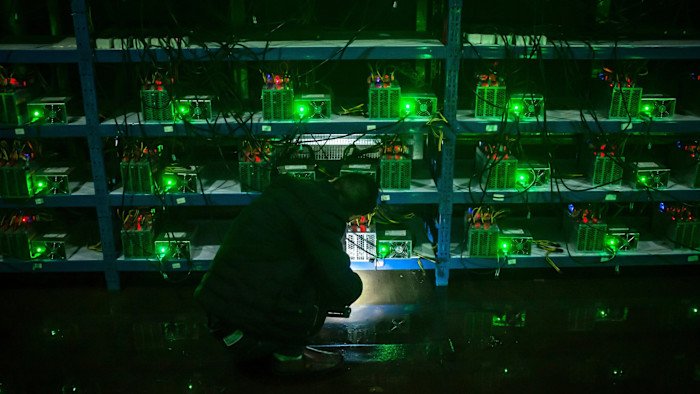

DigiByte was designed from day one with one clear priority: decentralization.
While many blockchains eventually drift toward concentrated validator sets or industrial-scale mining operations, DigiByte took a different approach. Its architecture actively works against centralization by distributing mining across multiple algorithms and encouraging participation from a wide range of hardware.
That design choice is not accidental.
It reflects a core belief behind DigiByte: a blockchain is only as strong as its distribution of power.
More than a decade after launch, that philosophy still shapes how DigiByte operates and how its community grows.
Why DigiByte Focuses on Mining Distribution
Unlike networks that rely on a single Proof of Work algorithm, DigiByte uses five alternating algorithms: SHA256, Scrypt, Skein, Qubit, and Odocrypt.
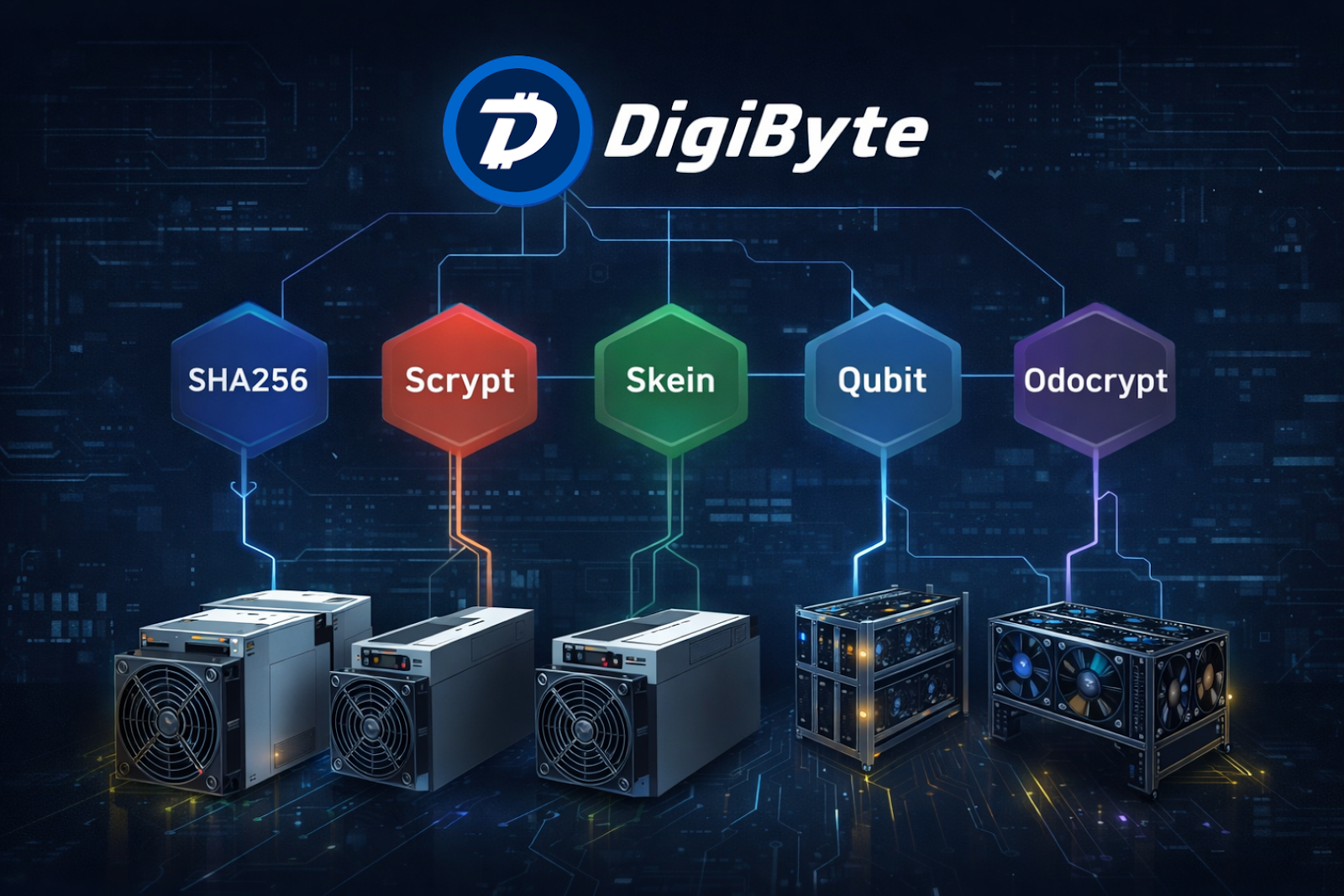
Each block rotates between these algorithms.
The practical result is that mining is spread across different types of hardware rather than dominated by a single ASIC class or manufacturer. Odocrypt, in particular, changes regularly, making long-term hardware optimization more difficult and encouraging GPU participation.
This multi-algorithm structure creates a more balanced mining ecosystem.
Instead of concentrating hash power into a few industrial operators, DigiByte enables miners of different sizes to contribute meaningfully to network security.
Security here is not about who has the biggest machines.
It is about how widely participation is distributed.
Fast Blocks and a Network Designed for Real Use
DigiByte produces blocks roughly every 15 seconds.
That speed improves transaction confirmation times and makes the network more practical for everyday use. Combined with Segregated Witness, DigiByte increases throughput while keeping the base layer lean and secure.
But speed alone is not the defining feature.
What matters is that DigiByte delivers this performance without sacrificing decentralization.
There is no validator cartel.
There is no staking authority.
There is no foundation controlling issuance.
Mining remains open, permissionless, and globally distributed.
That is increasingly rare in today’s blockchain landscape.
DigiDollar and Early Stablecoin Innovation
Beyond its base layer, DigiByte has also been working on DigiDollar, one of the earliest attempts at creating a decentralized stablecoin directly on a Proof of Work blockchain.

Unlike custodial or centrally issued stablecoins, DigiDollar is designed to operate without relying on traditional banking reserves or centralized control. It uses on-chain mechanics to maintain price stability while inheriting DigiByte’s security model.
While still evolving, DigiDollar reflects DigiByte’s broader philosophy.
Instead of outsourcing stability to third parties, the project continues to explore how essential financial primitives can exist natively on decentralized infrastructure.
It is another example of DigiByte’s long-standing focus on building practical tools directly on open networks, rather than layering dependence on centralized systems.
No ICO and a Minimal Community Premine
DigiByte launched in 2014 without an ICO and without venture capital backing.
There was a small premine of approximately 0.5 percent at launch. Importantly, this allocation was never distributed to the founder. Half of it was directed toward early developers to support infrastructure and ongoing development, while the other half was distributed directly to community members.

From the first block onward, the overwhelming majority of coins entered circulation through open Proof of Work mining.
This structure has long-term consequences.
There is no central treasury holding massive reserves. There is no venture-backed governance model steering development. Ownership spread organically through miners and early participants rather than private token sales.
Progress comes from open-source contributors, miners, node operators, and community builders around the world.
Growth may be slower than heavily funded projects.
But ownership remains broad.
Control remains distributed.
And the network remains resilient.
Why Solo Mining Still Has a Role
As mining becomes increasingly industrialized across many blockchains, smaller participants are often pushed to the sidelines.
Large pools dominate block production. Individual miners become invisible contributors to centralized infrastructure.
That trend directly conflicts with DigiByte’s original vision.
Solo mining offers an alternative.
Instead of pooling hash power and sharing rewards proportionally, solo miners work independently. When they find a block, they receive the full reward.
While variance is higher, the upside is meaningful participation in consensus and direct contribution to network security.
More importantly, solo mining helps preserve decentralization by preventing excessive reliance on large pools.
It brings block discovery back to individuals.
Supporting DigiByte’s Decentralized Mining Ethos
This is exactly where infrastructure like Bitmern Mining’s new solo pool fits naturally into the DigiByte ecosystem.

Through Bitmern Solo Pool, miners can participate in DigiByte mining independently while still benefiting from stable pool infrastructure.
The goal is not to centralize hash power.
The goal is to empower individual miners.
By lowering technical barriers to solo mining, Bitmern Solo Pool allows more people to participate directly in securing networks like DigiByte, whether they are operating from home or running small-scale setups.
This aligns directly with DigiByte’s multi-algorithm philosophy and long-standing commitment to decentralization.
It is infrastructure designed to support the network, not dominate it.
For miners who want to contribute directly to DigiByte’s security while maintaining independence, Bitmern Solo Pool provides dedicated solo pool infrastructure.
You can learn more about how it works at bitmernsolo.com.
Why the Foundations Matter
Crypto often focuses on price cycles, narratives, and short-term trends.
But blockchains are ultimately infrastructure.
They succeed or fail based on how well they distribute power, maintain security, and enable participation.
DigiByte has spent more than ten years proving that decentralized Proof of Work can still scale responsibly.
Five mining algorithms.
Fast block times.
Fair distribution.
Layered functionality through DigiAssets.
Passwordless authentication with Digi-ID.
These are not marketing features.
They are architectural decisions.
And they continue to matter.
Where DigiByte Fits in Today’s Crypto Landscape
DigiByte represents a different path in blockchain development.
It favors resilience over rapid expansion.
It prioritizes decentralization over convenience.
It builds slowly, openly, and without centralized control.
Mining is a core part of that story.
Whether through home rigs, small operations, or solo pools like Bitmern Solo, DigiByte remains one of the few networks where individual participation still has real impact.
In an industry increasingly shaped by institutional validators and venture-backed chains, DigiByte continues to operate under a model that puts power back in the hands of the community.
That is not just technical design.
That is philosophy.
A Network Built to Last
DigiByte was built to resist centralization.
Its multi-algorithm mining model, fast blocks, and fair launch were deliberate choices aimed at creating a durable, decentralized network.
Supporting that vision requires infrastructure that empowers miners rather than replaces them.
Solo mining plays a meaningful role in that ecosystem, and platforms like Bitmern Solo exist to make that participation accessible.
For anyone who believes blockchain should remain open, distributed, and community-driven, DigiByte remains one of the strongest examples of how those principles can survive in a rapidly changing industry.
Join the Bitmern Pool here: bitmernsolo.com.
By Giannis Andreou